
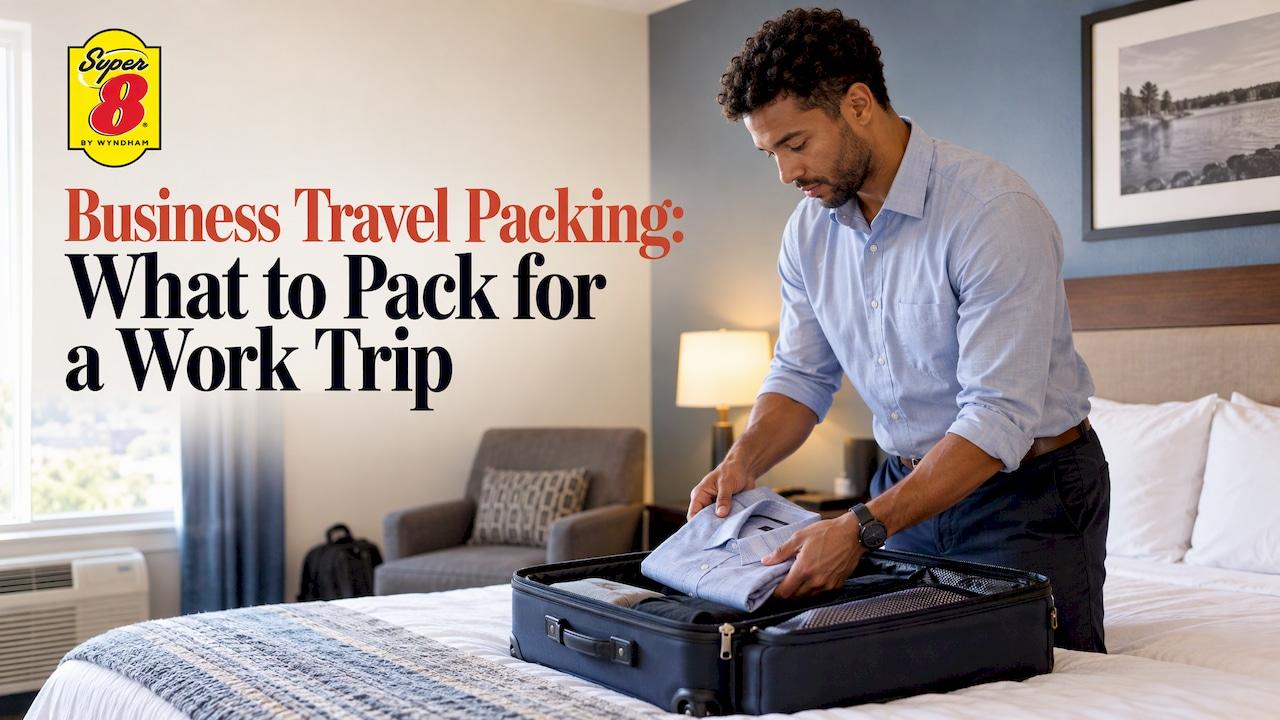
Pack for your calendar, not for your fears. For most work trips of up to five days, that means one carry-on, a small set of clothes that mix and match, a tech pouch, your documents, and a liquids bag that meets TSA rules. The rest depends on where you sleep: a room with free Wi-Fi, a hot breakfast and a pool, like ours at Super 8 by Wyndham in Watertown, South Dakota, lets you leave a surprising amount at home.
This guide gives you the list, the reasoning behind it, and how to adjust it for trip length, weather and the kind of lodging you will have.
TL;DR
- Build outfits around your meetings and events, then make every item work with at least two others.
- Keep laptop, chargers, power bank, medication and documents in the bag that stays with you, never in checked luggage.
- Carry-on liquids must be 3.4 oz (100 ml) or less, all in one quart-size bag. Medications are handled separately.
- For trips beyond five days, plan laundry or repeat pieces instead of packing more.
- Choose a hotel that covers breakfast, Wi-Fi and parking so your bag carries less.
Table of Contents
- Start with the schedule, not the suitcase
- How much clothing for how many days
- Choose clothes that survive a bag
- Adjust for weather and destination
- The tech pouch
- Documents and money
- Toiletries and the TSA liquids rule
- Carry-on versus checked
- What the hotel lets you leave at home
- Special cases: crews, drivers and longer stays
- A last-minute checklist
- Where to stay in Watertown
- Our view on packing for a work trip
- FAQ
- Sources
Start with the schedule, not the suitcase
The most useful packing advice we found is to start from your calendar. Von Baer's packing guidance says to count outfit changes by event and pack for the most formal one. It also says that building outfits around specific slots, with every piece working in at least two outfits, typically cuts bag volume by 30 to 40 percent.
In practice, write out each day in three lines: morning, afternoon, evening. Next to each, note the dress level (client meeting, site visit, team dinner, nothing). You will usually find you need two or three distinct looks, not seven.
Two extra rules keep the bag honest:
- Cap the "just in case" items at two. The PACK Method suggests this limit, and it is a good filter. An umbrella you will use beats a third spare tie you will not.
- Plan for zero recovery time. If you land late and have an early meeting, assume the shirt you pull out is the one you wear.
How much clothing for how many days
The longer the trip, the more you repeat pieces and the more you rely on laundry. Holafly's trip-length guide breaks it down like this:
| Trip length | What to pack |
|---|---|
| 1 to 2 days | One suit or outfit, a fresh shirt for each day, one pair of shoes |
| 3 to 4 days | Two suits or jackets, four shirts or tops, one or two layers, in a carry-on with packing cubes |
| 5 to 7 days | Repeat jackets and pants; use laundry or pressing for shirts |
| 2+ weeks | About a week of clothes, with laundry on the weekend |
Stow's packing guide agrees that carry-on only works for most professional trips up to five days. For three to five days, you can pack for three and do laundry, or add one extra shirt and one extra pair of trousers to cover five days with none.
A sample three-day bag
Here is a combined list drawn from the checklists we reviewed, enough for most office-and-client trips:
- One jacket or blazer, worn on the plane
- Two bottoms (one dark dress pant or skirt, one casual)
- Three tops, including one collared shirt per formal day
- One pair of smart shoes and one comfortable pair, with the bulkier pair worn while traveling
- Underwear and socks for each day plus one spare
- Sleepwear and one set of workout clothes
- One layer for cold planes and meeting rooms
This follows the structure of Works Travel's three-day list. The New York Times basic business checklist is a little more generous: 4 to 5 tops, 3 bottoms, one semi-formal outfit, 7 undergarments and socks, two sets of exercise clothes, plus a foldable jacket and a foldable rain jacket. Scale up or down depending on how often you want to do laundry.
Choose clothes that survive a bag
Fabric matters more than quantity. Works Travel advises that knits, wool blends and synthetic blends resist creasing better than crisp cotton or linen. Darker colors and small patterns hide marks. Layers handle cold meeting rooms and warm streets.
Two small habits save time:
- Wear the bulkiest item. Putting the blazer or suit jacket on for the flight avoids the worst wrinkles, a tip Allianz Partners' business packing list includes along with a small fix-it kit of Band-Aids, safety pins, antacids and a stain-removal stick.
- Use steam, not an iron. Hanging creased clothes in the bathroom while you shower loosens wrinkles, per the same Works Travel guide.
Know your dress code
If your trip involves interviews, presentations or networking, check what the event expects. A university career center's business attire guide defines Business Professional as a full suit in navy, black or charcoal with closed-toe leather shoes. Business Casual is collared shirts, tailored pants or skirts and clean, simple shoes. Both exclude jeans, sneakers and T-shirts, and the guide notes it is better to overdress than underdress.
Footwear
Shoes are the heaviest thing in your bag, so limit yourself to two pairs. The Manual suggests classic oxfords or loafers plus a casual outfit for downtime. A shoe that works with both your suit and your evening plans, in a color that matches everything, does the most for the space.
Adjust for weather and destination
The same bag has to work in different climates. Esquire's three-day guide suggests an unlined seersucker or linen-mix suit for hot weather, because pure linen creases too much, and a simple raincoat for rain. For cold, it recommends a quilted down or fleece vest under the raincoat or a wool overcoat, plus a scarf or a beanie, but not both.
When the trip crosses climates, JetKit's advice for back-to-back meetings is a core wardrobe of a lightweight blazer, dark pants and a weather-flexible outer layer. Add a base layer, a light knit and one outer piece as your layering system, and one closed-toe shoe that works in both places.
If you are heading somewhere properly cold, a layer-by-layer winter clothing guide shows how to build warmth without bulk. The same logic applies to a late-autumn site visit on the northern plains: thin layers you can add or remove beat one heavy coat.
Also check local dress norms. Holafly notes that expectations for meetings and dinners vary by country, so a quick search before you pack prevents an overpacked or underdressed trip.

The tech pouch
Your laptop is the one item that should never leave your hands. Tortuga's business packing guide says to use a carry-on plus a personal item for the laptop and never check it.
A reliable tech kit:
- Laptop and charger
- Phone, cable and a spare cable
- Portable power bank (in your carry-on, not checked)
- Headphones or earbuds
- Adapter if you are traveling internationally
- A Wi-Fi hotspot if you work somewhere with weak connections, as Indeed's work-trip list suggests for airports, hotels and convention centers
Save presentations and documents on the laptop itself, not only online. TripDeputy's guide recommends this in case venue Wi-Fi fails, along with saving meeting addresses and contacts offline.
One safety point: power banks and spare lithium batteries must travel in carry-on bags, never checked, according to passportprotravel.com's 2026 rules summary.
Documents and money
For flights inside the United States, adults need acceptable ID. Indeed's list notes that a REAL ID-compliant license, an enhanced ID or another accepted ID is required for travelers 18 and older. A REAL ID is a state license or ID that meets federal security standards, usually marked with a star. A passport also works.
Beyond ID, pack:
- Printed or digitally organized airline reservations, hotel confirmation and rental car details
- A wallet with a debit card, credit card and small bills
- Business cards, a notebook and two pens
- A folder or envelope for paper receipts. TripDeputy suggests photographing each one, following your company's expense policy.
- A printed backup of key documents, as the PACK Method recommends
Toiletries and the TSA liquids rule
This is where carry-on trips go wrong. The TSA travel checklist says liquids, gels and aerosols in carry-on bags must be in containers of 3.4 ounces or less, all fitting in one quart-size clear zip-top bag, one bag per passenger. The rule is based on container size, not what is left inside, so a half-empty large bottle does not qualify.

The same page says box cutters, utility knives and razors are not allowed in carry-on luggage, though shaving blades enclosed in a safety cartridge are permitted.
Medications are treated differently. Medically necessary liquids can exceed 3.4 ounces and do not need to go in the quart bag, but should be removed for separate screening and declared to the officer. Keep prescriptions in their original pharmacy containers. AAA also advises carrying prescription medications with you rather than checking them. If you take a medicine regularly, ask your doctor or pharmacist how much to bring and whether your trip needs special handling.
Airport screening is changing. TSA is deploying CT scanners at more airports, but TripMojo's analysis stresses that these change how screening works, not the liquid limit, and recommends packing to the strictest standard because rollout is uneven.
A compact toiletry kit
- Toothbrush, travel toothpaste, floss
- Deodorant, razor with enclosed cartridge, small shave cream
- Travel-size shampoo and conditioner, or use hotel supplies
- Skincare, lip balm and sunscreen in small containers
- Contacts and solution, or glasses
- Over-the-counter basics such as pain relievers and rehydration packets
- Earplugs and an eye mask
The Allianz Partners toiletry list is longer, so use it as a menu, not a requirement.
Carry-on versus checked
Most major U.S. airlines set carry-on limits of about 22 x 14 x 9 inches, and TSA does not set carry-on size or weight limits itself: the airline does. Check your carrier's page before you fly.
If you do check a bag, AAA's advice is to keep a 24-hour supply of clothes and toiletries in the carry-on in case the bag is delayed. AAA also says to avoid putting your home address on luggage tags. Use a cell phone number or work contact instead, and keep a photo of your checked bag for lost-luggage reports.
What the hotel lets you leave at home
Where you sleep changes what you carry. A well-chosen business hotel replaces several items on every packing list:
- Free Wi-Fi means less reliance on a hotspot for evening work. If this matters to you, our guide to hotel rooms with free Wi-Fi in Watertown covers what to look for.
- Breakfast included removes the need for travel snacks on the first morning. We cover what to know in free breakfast hotels.
- A pool and hot tub make a second set of workout clothes optional, since a swim can replace a gym session after a long day.
- Room TVs and a desk-friendly layout mean fewer entertainment items in the bag.
If you are choosing between properties, how to choose business traveler hotels walks through the criteria. If you will be arriving after dark, late check-in hotels explains how to keep your room.
Special cases: crews, drivers and longer stays
Not every work trip is a flight with a suit bag. Construction crews, wind technicians and truck drivers pack differently: work boots, durable layers, tools or gear that live in a truck, and enough clothing for weeks, not days.
For these trips, the main packing question is parking and storage. A lot that fits trucks, pickups, trailers and RVs lets you keep gear in the vehicle and bring only a duffel inside. See truck driver hotels and safe hotel parking for what to check.
For assignments longer than a week, pack about seven days of clothing and plan weekly laundry, as the longer-trip guidance above suggests. The details of rates and taxes are in our guide to weekly hotel stays. Traveling with a dog or cat? Pack their food, bowl and bedding, and read pet friendly extended stay hotels before you book.
A last-minute checklist
Run through this the night before you leave:
- Can I wear every top with at least two bottoms?
- Are my laptop, power bank, medication and documents in the bag that stays with me?
- Do my liquids fit in one quart bag, each 3.4 oz or less?
- Do I have the hotel confirmation and address saved offline?
- Have I put on the bulkiest jacket and shoes instead of packing them?
- Is there room left in the bag? If not, remove one thing.
Where to stay in Watertown
If your work takes you to Watertown, South Dakota, we welcome business travelers, crews and families at Super 8 by Wyndham, 503 14th Avenue SE. Our King and Two Queen Bed rooms come with complimentary high-speed Wi-Fi, 50-inch flat-screen TVs and a complimentary continental breakfast with a rotating selection of hot and cold items. There is an indoor pool and hot tub, spacious parking for trucks, pickups, trailers and RVs, pet-friendly rooms, and flexible weekly and group options for crews.

See the rooms and request a stay or group rate on our Super 8 Watertown page.
Our view on packing for a work trip
We talk with business travelers, crews and families, and the lesson is the same: the lighter you arrive, the better the trip goes.
Pack the work essentials, the laptop, the documents, the clothes for your meetings, and let the room handle the rest. That is why we built our stay around things you would otherwise carry or hunt for: complimentary Wi-Fi, a complimentary breakfast with hot items such as biscuits and gravy, eggs and waffles, and parking that fits a truck, a trailer or an RV.
For crews on longer assignments, we offer weekly and group arrangements, so you can settle in rather than live out of a bag. After a long day, the indoor pool, the hot tub and a movie on our poolside screen are there to help you reset before tomorrow.
Pack for your schedule, then come stay with us in Watertown.
stayats8llc
FAQ
What is the 3-3-3 rule for travel packing?
It is a capsule-wardrobe shortcut, usually three tops, three bottoms and three pairs of shoes, though versions vary. It works well for a trip of about three days and is easy to stretch with laundry. For work trips, make sure at least one item in each group meets your dress code.
Can I bring a laptop and liquids through TSA in a carry-on?
Yes. Keep your laptop in the bag you carry on, never checked. Liquids must follow the 3.4 oz, one quart-size bag rule from the TSA travel checklist. Some CT-equipped lanes may let you leave items in the bag, but the size limit still applies, so pack as if every checkpoint is strict.
How many outfits do I need for a week-long business trip?
Plan about three to four days of outfits and repeat jackets and pants, with fresh shirts and underwear for each day. Use laundry or steaming to refresh. The PACK Method suggests this approach when laundry is available, and it keeps the bag at carry-on size for most trips.
Should I wear my suit on the plane?
On shorter trips, yes, especially if you go straight to a meeting. Travel + Leisure notes that wearing the suit avoids packing it. A garment bag protects clothes on longer trips with checked luggage but takes more space.
Sources
- Von Baer: How to Pack for a Business Trip
- The PACK Method
- Holafly: Business trip packing list
- Stow: Business travel packing list
- Works Travel: Packing for a Work Trip
- New York Times: Basic Travel Checklist
- Allianz Partners: Business travel packing list
- CSUN: Business attire guide
- The Manual: Business trip packing list
- Esquire: Business trip packing list
- JetKit: Back-to-back client meetings
- Tortuga: Business trip packing lists
- Indeed: What to take on a work trip
- TripDeputy: The business trip packing list
- passportprotravel.com: TSA carry-on restrictions
- TSA: Travel checklist
- TechBloat: TSA rules
- AAA: Travel packing tips
- TripMojo: TSA carry-on rules
- Travel + Leisure: Business trip packing list
- Layer-by-layer winter clothing guide