
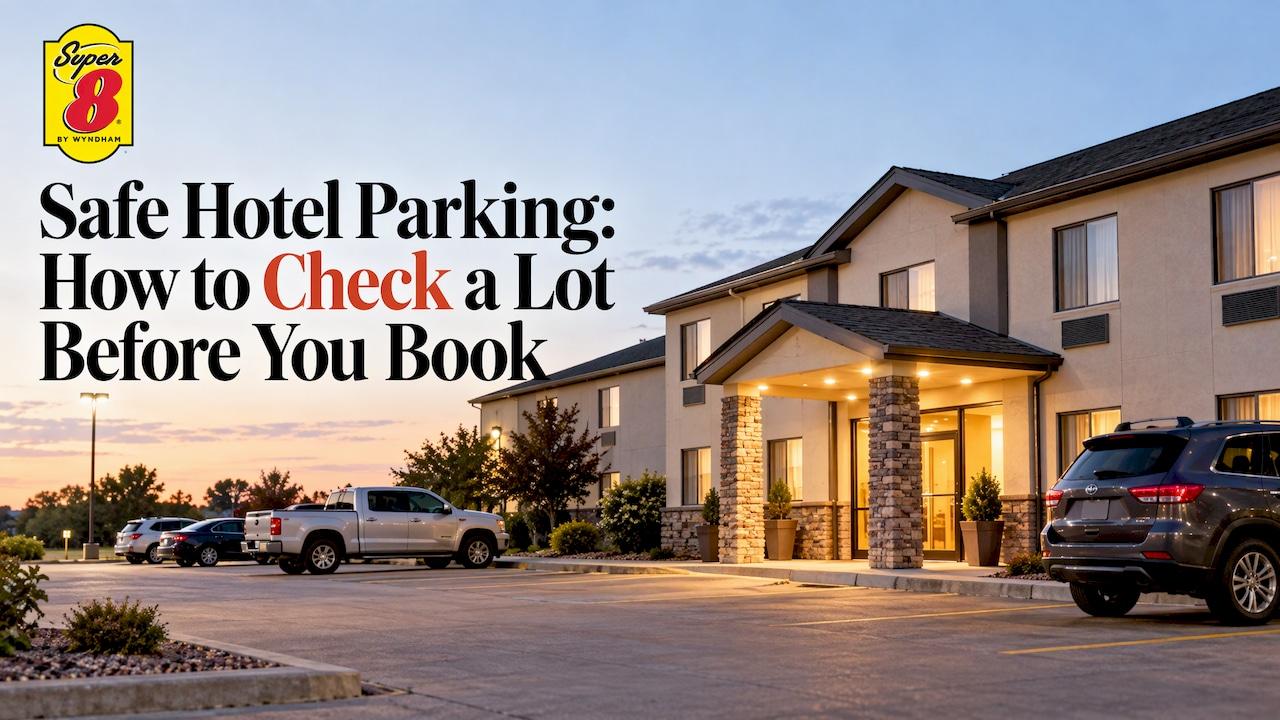
Safe hotel parking comes down to four things you can judge before you arrive: light, visibility from the building, clear rules for your vehicle, and room for it to fit. In Watertown, South Dakota, our hotel at 503 14th Avenue SE has spacious parking for trucks, pickups, trailers and RVs, so large rigs have space on site instead of on a city street. Below is how to size up any lot, what to do once you park, and the local rules that catch visitors out.
TL;DR
- "Secure" is a marketing word. It can mean anything from a lit public street to a gated, patrolled facility, so ask what it means in specifics.
- Remove valuables from the vehicle, park in a lit, busy spot near the lobby, and keep your keys in hand.
- Overnight parking does not automatically mean you may sleep in the vehicle. Ask before you do.
- Oversized vehicles need length, height, trailer and turning-radius answers before you book.
- In Watertown, avoid leaving a vehicle on a city street for more than 24 hours, and watch snow emergency rules in winter.
Table of Contents
- What "secure" parking really means
- Questions to ask before you book
- How to pick a spot once you arrive
- What to do with your vehicle and belongings
- Overnight parking rules, and sleeping in your vehicle
- Trucks, trailers, RVs and other big vehicles
- Fees, billing and checkout traps
- Watertown street parking rules to know
- Perspective
- Book a stay with room for your vehicle
- FAQ
- Sources
What "secure" parking really means
Hotels use the word loosely. One aggregator guide on verifying hotel parking points out that the word can describe anything from a well-lit public street to a fully gated, patrolled facility. The same guide reports that parking areas have shown the highest potential for litigation over crimes that occurred there, which is why it pays to look closely.
The duty a hotel takes on also differs by type of parking. A hotel security management manual describes three levels of duty of care: the highest for valet-parked cars, an intermediate level for controlled paid parking, and the lowest for self-parking. Most hotels in smaller cities, including ours, are self-park lots, so your own habits do much of the work. That is good news, because habits are easy to control.
The same manual recommends that outdoor lots average at least 2 foot-candles of illumination with no area below 1, and indoor lots at least 5 foot-candles. You will not carry a light meter, but the standard shows what the goal is: no dark pockets where someone can work on a car unseen.

Questions to ask before you book
A phone call takes two minutes and replaces guesswork. These are the questions worth asking about any lot:
- Is the lot lit all night, and can you see it from the building? Safemark, a parking-lot security company, suggests asking whether local police do regular drive-bys and whether cars are easily seen from hotel windows.
- Are there cameras, and are they recorded or just a live feed? The verification guide above recommends asking whether coverage is recorded around the clock or merely passive.
- What does the hotel say about liability? Many self-park lots post a notice that vehicles are left at the owner's risk. The security manual even gives sample wording. Knowing this helps you decide what to leave in the car (nothing) and whether to check your own auto policy.
- Is parking free, and how is it billed? The average hotel parking fee in the U.S. is $44 a night, according to ResortFeeChecker.com research cited by Travelers United, and New York, San Francisco and Chicago each average more than $60. Small-city hotels often charge nothing, so a free lot is worth confirming.
- Will my vehicle fit? More on that below.
You can also use Street View to look at the entrance and lot layout, and skim recent reviews for words like "tight" or "small spaces." Those two steps catch most surprises.
How to pick a spot once you arrive
Even a well-run lot gives you choices, and where you park matters as much as which hotel you picked. The advice from police departments and security specialists is consistent:
- Park under or near a light, in a populated area. The Seattle Police Department advises well-lit, populated areas for overnight stops.
- Choose a spot you can see. Safemark recommends parking where you can see your vehicle from your room window or near the lobby, and avoiding far dark corners, spots under thick trees, or places behind dumpsters.
- Ask for a better space if the lot feels wrong. A hotel desk would rather move you than deal with a break-in report. A space is fine when light reaches the car and people walk past it.
A practical trick: pick your room and your parking space together. When you check in, ask for a room with a view of the lot or close to the door nearest where you will park. Our King and Two Queen Bed rooms are on a property with its own lot, so you can look at where you will leave your vehicle before you carry your bags in.
What to do with your vehicle and belongings
Most parking-lot crime is opportunistic: someone sees a bag, a laptop or a charging cable and breaks a window. The fix is boring and works.
Take valuables inside. The Seattle Police Department says to remove bags and other valuables and take them inside when you stop overnight. The Nashville police tourist safety tips say never to leave valuables in your vehicle at a hotel or motel, and to remove money and valuables and lock the doors in parking lots. If something must stay, Seattle's advice is to lock it in the trunk before you arrive at the lot, since someone may be watching you load it.
Lock everything. Even for a minute, lock all doors and close windows and sunroofs fully.
Use the room safe. Safemark recommends the hotel safe for cash, cards, IDs and electronics.
Walk to the car with keys in hand. Check the spaces between cars and around your vehicle before approaching, and look in the back seat before you get in, as Seattle's guidance puts it.
Consider small deterrents. A vehicle safety checklist from TheFixCar suggests keeping a key fob in a signal-blocking pouch, adding a visible steering wheel lock, and walking around the car in the morning to check for damage.
If you carry gear for work, such as tools, hunting equipment or electronics, bring in what you can and store the rest out of sight in lockable bins rather than loose piles on seats or in the cargo area.
Overnight parking rules, and sleeping in your vehicle
Many readers type this question because they are on a long drive. Two separate issues get mixed up.
Leaving a vehicle overnight. For a registered guest, that is the normal arrangement. If you are not staying, it is allowed only if the hotel's policy or management permits it and you follow posted signs and local law, according to Catalyst Legal's guidance.
Sleeping in the vehicle. The same guidance says that parking being available does not authorize sleeping in the vehicle. Permission depends on the property's rules, management and state or local law. Ask explicitly whether it is allowed, where, for how long and whether you must be a registered guest, and get the conditions in writing if you can. It also warns against running a generator, camp stove or fuel-burning heater inside the vehicle.
The simplest answer for a tired driver is a bed. If you are arriving late, our guide to late check-in hotels explains how to arrive after dark and still keep your room.

Trucks, trailers, RVs and other big vehicles
Standard parking questions are not enough for a rig. A hotel parking guide lists what to confirm for oversized vehicles: maximum length and height, whether trailers may stay attached, turning radius, entrance width, whether box trucks, shuttles or buses are permitted, and whether oversized parking costs extra. It also says to contact the property directly rather than rely on a listing.
This matters because a lot that technically has "parking" may have a low canopy, tight rows or a narrow entrance. A driver who finds that out at 10 p.m. often ends up parked on a street or in a spot that blocks other vehicles.
We welcome construction crews, wind energy technicians, truck drivers, hunters and extended-stay guests, and our hotel offers spacious parking for trucks, pickups, trailers and RVs. If you are planning around a big vehicle, these two guides go deeper:
- Truck parking hotels, on finding a stay that fits your rig.
- Hotels with RV parking, on how to find one and book it right.
When you contact us, have your vehicle's length, height and trailer setup ready. It makes planning simpler for everyone. For drivers on the road for work, the truck driver hotels guide covers what to look for.
Fees, billing and checkout traps
Parking costs can surprise you at checkout, so settle these points at booking:
- Is parking self-park, valet, garage or off-site?
- Is it guaranteed, reservable or first-come?
- Are taxes, service charges or valet tips extra?
- Is it charged per hotel night or per 24 hours, and does a late checkout extend it?
The Hotelier.cloud guide recommends confirming the type, cost and billing basis before arrival. A travel blog on hotel parking rules adds that guests should ask when the parking day starts and ends, whether there is a checkout grace period, and whether leaving the lot starts a new session.
For longer stays, the same billing questions apply week after week. Our weekly hotel stays guide covers rates, taxes and what to check.
Watertown street parking rules to know
The best way to avoid street-parking trouble in Watertown is to park on the hotel's lot. For visitors who do leave a vehicle on a city street, the city's revised ordinances (updated to June 12, 2026) set these limits:
- A vehicle, including a trailer, generally may not stay in one street or avenue right-of-way location for more than 24 consecutive hours. It must then move at least 50 feet.
- Semi-tractors, semi-trailers, watercraft trailers and campers or RVs may not be left on streets, boulevards, alleys or public places in residential districts, except for reasonable loading or unloading.
- During a declared snow emergency, vehicles including trailers may not remain on streets on Monday, Wednesday or Friday, or on avenues on Tuesday, Thursday or Saturday, until the applicable roadway has been plowed. The city says violators may be ticketed or towed at the owner's expense.
South Dakota winters make that last rule real. If you are visiting between late fall and early spring, check the city's current snow emergency notices when you arrive and keep your vehicle on the hotel lot.
Perspective
Parking is where a trip tends to go wrong quietly. Nobody plans around it, and then you are walking a dark block with a bag at 11 p.m., or backing a trailer out of a lot that was never built for it.
Our guests are often the people who arrive with the most vehicle: crews with pickups and trailers, drivers, hunters, families with an RV. That is why we offer spacious parking for trucks, pickups, trailers and RVs, and why we welcome weekly and group stays. Your vehicle is part of the trip, and the lot should be planned with that in mind.
Our advice is simple. Choose a hotel where your vehicle fits, park in the light near the building, and bring your valuables inside. Our rooms, with a King bed or Two Queen Beds, free high-speed Wi-Fi, a complimentary continental breakfast and an indoor pool and hot tub, give you a place to settle once the vehicle is sorted.
stayats8llc
Book a stay with room for your vehicle
Super 8 by Wyndham Watertown is at 503 14th Avenue SE, Watertown, SD 57201. We offer King rooms and Two Queen Bed rooms, weekly and crew stays, group booking options and pet-friendly accommodations, along with spacious parking for trucks, pickups, trailers and RVs. Mention your vehicle type when you book so your stay is set up around it.

See the room types and request a group or weekly rate on the Super 8 Watertown booking page.
FAQ
Can you spend the night in a hotel parking lot?
You can leave a vehicle overnight if the hotel's policy or management allows it and you follow posted signs and local law. Parking permission does not mean you may sleep in the vehicle. Ask explicitly and get the terms in writing if possible.
What is the safest way to park at a hotel?
Park in a well-lit, busy spot near the lobby or within view of your window. Take valuables inside, lock all doors and close windows fully. Have your keys in hand when you walk back to the vehicle.
How do I know if hotel parking is actually secure?
Ask specific questions: how the lot is lit, whether cameras record or only stream live, and what the hotel's liability notice says. Then look at the lot on arrival. Light that reaches the cars and people walking past are good signs.
Does the hotel have parking for trucks, trailers and RVs?
Yes. Our Watertown hotel offers spacious parking for trucks, pickups, trailers and RVs. Share your vehicle's length and setup when you book.
Sources
- Is Your Hotel's 'Secure' Parking A Myth? A Verification Guide
- Security Operations/Risk Management Manual
- Hotel Parking Lot Safety, Safemark
- Visitor Safety Tips, Seattle Police Department
- Tourist Self-Awareness Safety Tips, Nashville.gov
- Hotel Parking Safety Checklist for Road Trips, TheFixCar
- Can You Sleep in Your Car in a Hotel Parking Lot?, Catalyst Legal
- Hotels With Parking Guide: Free, Valet and EV
- Hotels charge parking fees, Travelers United
- 5 Hotel Parking Rules Guests Often Discover Only at Checkout