
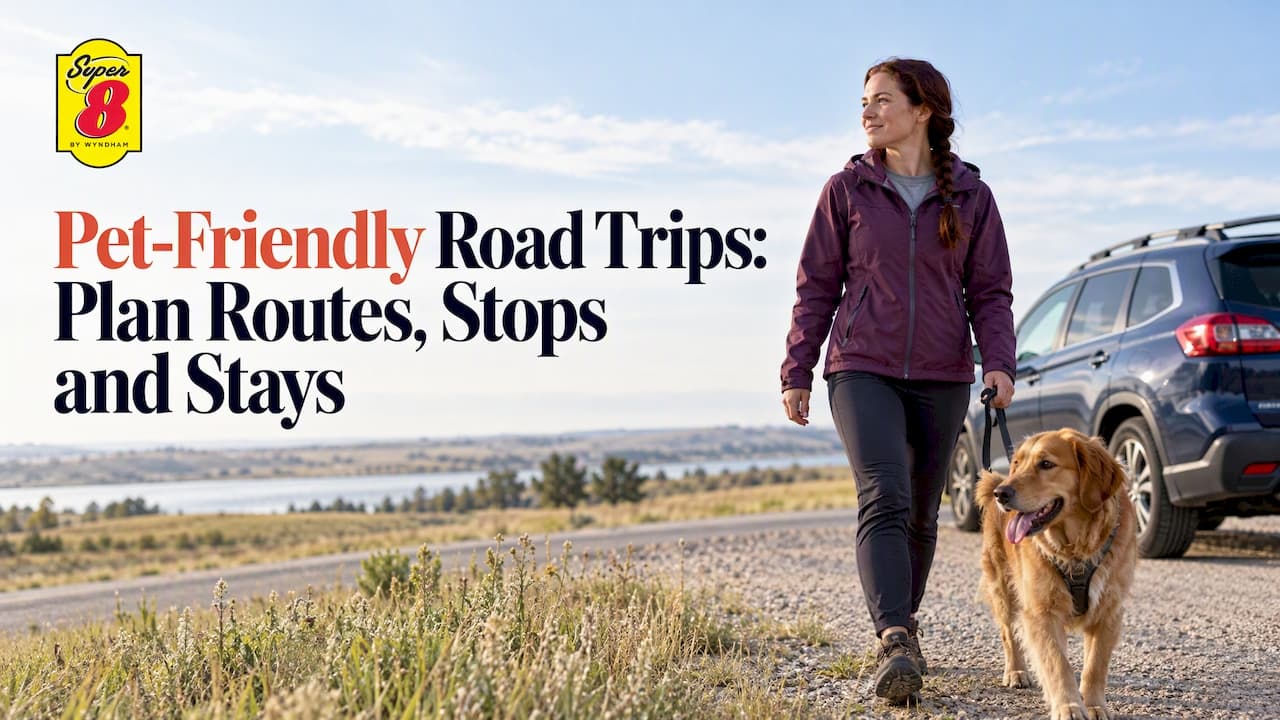
A good road trip with a dog comes down to four things: a route with real dog-friendly stops, a safely secured dog in the car, a plan for rest breaks, and a bed you have confirmed will welcome you both. Get those right and the miles are the fun part. This guide covers all four, with named routes, park rules worth checking, and the questions to ask any hotel before you book.
TL;DR
- Pick a route where dogs are welcome on trails, beaches and in towns. The Pacific Coast Highway, Blue Ridge Parkway and Florida Keys are common picks.
- Secure your dog in a crate or a harness clipped to the seat belt, stop often, and never leave a pet alone in a parked car.
- Rules change from one park, beach or season to the next, so check leash and access rules for each stop before you leave.
- Ask every hotel about fees, breed limits, pet counts and whether you can leave your dog alone in the room.
Table of Contents
- Routes that work well with a dog
- How to choose a route for your dog
- Get the car ready first
- Check the rules at every stop
- Finding places to eat and rest
- What to ask a hotel before you book
- A sample day on a dog road trip
- Our perspective
- Stay with us in Watertown
- FAQ
- Sources
Routes that work well with a dog
The best dog road trips share a few traits: long stretches of scenic driving, frequent places to get out and walk, and towns used to visitors with leashes. A few routes come up again and again.
Whisker Bark's road-trip list suggests the Pacific Coast Highway from San Francisco to San Diego, the 469-mile Blue Ridge Parkway from Virginia to North Carolina, historic Route 66 from Illinois to California, the 113-mile Florida Keys Scenic Highway from Miami to Key West, and a Glacier-to-Yellowstone drive. That gives you coast, mountains, desert and islands, so you can match the route to your dog's temperament and coat.
Coastal and mountain drives
California's coast is the classic. Visit California's dog-friendly guide recommends stops such as Carmel Beach, Asilomar State Beach, Huntington Dog Beach, Del Mar Dog Beach, Ocean Beach's Original Dog Beach and Fort Funston in San Francisco. It also notes that cultural and historical destinations are increasingly welcoming to traveling dogs, so the trip is not only beaches.

In the East, The Pet Times points to Acadia National Park, the Great North Woods, Dog Mountain in Vermont, Provincetown, Rock Creek Park, the Blue Ridge Parkway and New River Gorge as dog-oriented destinations. It also tells travelers to verify each site's leash and access rules, which is advice worth following everywhere.
If your dog loves a good wander, Rover's road-trip roundup describes Dog Mountain in St. Johnsbury, Vermont, as dog-friendly year-round, with trails, a pond and a dog chapel.
The desert Southwest
A loop through Las Vegas, Red Rock Canyon, Sedona, the Grand Canyon, Zion and Bryce Canyon can work with a dog, but you need to know where dogs are allowed. USA Today's 10Best itinerary reports that:
- Red Rock Canyon permits leashed dogs on trails and its 13-mile scenic drive.
- The Grand Canyon permits leashed dogs on the paved 12-mile Rim Trail and the 2-mile Shoshone Point hike.
- At Zion, the paved 3.5-mile Pa'rus Trail is the dog-accessible option, and dogs are not allowed on the Zion Canyon Scenic Drive shuttle.
That last point shows why route research matters. A famous park can be a poor fit for a dog while the same state offers a better trail a few miles away.
How to choose a route for your dog
Don't start with the prettiest map. Start with your dog.
- Drive time per day. Dogs need frequent breaks. A route that needs eight hours a day behind the wheel will wear down both of you. Plan shorter legs, and treat the stops as part of the day, not delays.
- Weather and surfaces. Hot pavement, cold snaps and rough rock all matter. A short-nosed breed, a senior dog and a husky have very different limits.
- Where dogs can actually go. Some national parks limit dogs to paved paths and parking areas. Roadtrippers notes that Acadia in Maine is very dog-friendly with over 100 miles of trails, while Glacier has severe restrictions meant to protect wildlife. Two famous parks can give you opposite experiences.
- Your own comfort. If your dog will spend hours in a hotel room while you sightsee, you need a plan for that (more on this below).
Get the car ready first
Most problems on a dog road trip start in the car, not at the destination. The CDC's pet travel guidance is the best single checklist.
Practice before the big drive
The CDC suggests short practice drives so your dog gets used to the car. Start with a ten-minute loop and work up. A dog that gets anxious or carsick on a short drive will not magically relax on day two of a long one. If your dog is anxious, ask your veterinarian about options before the trip.
Secure your dog
The CDC recommends a secured, well-ventilated crate or a back-seat harness attached to the seat belt. A dog should never ride loose in the vehicle or put its head out of the window. Roadtrippers adds that hanging the head out of a window is dangerous and dries out a dog's eyes.
Never leave a pet in a parked car
The CDC is clear that you should never leave a pet alone in a parked vehicle. Temperatures inside can climb quickly in warm weather and fall to dangerous lows in winter. Plan meals and stops so that someone can always stay with the dog, or choose places with outdoor seating where dogs are welcome.
What to pack
The CDC's list includes:
- Water, food and bowls
- A leash and waste bags
- Medication and first-aid supplies
- Rabies vaccination documentation
The agency also advises feeding several hours before departure and stopping frequently for bathroom breaks and stretching. If you cross state lines, check each state's entry requirements ahead of time.
Watch for ticks and wildlife
The CDC also recommends supervising your dog, avoiding wildlife and unsafe water, and checking for ticks after outdoor activities. Build a quick tick check into your evening routine at the hotel, before you settle in for the night.
Check the rules at every stop
Leash laws, fees and seasonal closures can turn a good plan into a wasted drive. A few examples show how specific the rules get.
Seasonal beach closures. Oregon Coast Visitors Association advises checking leash laws and seasonal restrictions, since rules vary along the coast. Western snowy plover nesting season runs March 15 through September 15, and recreation in designated plover-management areas is often restricted or prohibited.
Park fees and reservations. According to USA Today's 10Best, at the time of its November 2024 article Red Rock Canyon's 13-mile scenic drive required timed reservations and a $20 per vehicle fee, and the Grand Canyon charged $35 per vehicle at entry. Fees change, so confirm current amounts on the park's official page.
A quick pre-trip routine. For each stop on your list, check three things: are dogs allowed on the trail or beach you want, must they be leashed, and is there a seasonal closure or reservation requirement? Write the answer in your trip notes so you are not hunting for signal at a trailhead.
Finding places to eat and rest
Dog-friendly patios, parks and rest areas make long days easier. Pet-friendly road trip planners and map views help you spot accommodations near parks and services, as Visit California suggests. The idea is simple: pick your overnight stop first, then see what is within a short walk or drive.
That approach works anywhere. When you plan each day around where you will sleep, you can list the nearby green spaces, coffee stops and basic services before you arrive. Tools that let you map nearby parks and cafes make that kind of lodging-first planning faster, whether you are in a big city or a small town.
Keep your evening short and easy. After a long drive, a dog usually wants a walk, water, a meal and a quiet place to settle. Choose a hotel with easy access to a grass area and a door close to your parking spot, so those routines take minutes, not a trek through the lobby.

What to ask a hotel before you book
"Pet friendly" on a listing is only the start. Policies differ a lot between properties. Visit California's guidance is to check hotel pet policies explicitly for fees, breed restrictions and the number of pets allowed, since these vary significantly by location.
Here is a practical question list to use on the phone or in an email:
| Question | Why it matters |
|---|---|
| Is there a pet fee, and is it per night or per stay? | It changes the real cost of a multi-night stop. |
| Are there breed or size limits? | A policy that fits a terrier may not fit a lab. |
| How many pets can stay in one room? | Matters if you travel with two dogs. |
| Can I leave my dog alone in the room? | Decides whether you can eat out or visit an attraction. |
| Which rooms are used for pets, and where do dogs walk? | Affects noise, comfort and cleanup. |
| What are the parking arrangements? | Important if you tow a trailer or drive a large vehicle. |
If you are planning a longer stay, our guide to pet-friendly extended stay hotels goes deeper on what to check before you book. And if your vehicle is big, our notes on truck parking hotels explain what to look for in a stay that fits your rig.
Leaving your dog in the room
Many hotels prohibit leaving pets unattended in rooms, according to Roadtrippers. If you plan to go out for dinner without your dog, ask first. If the answer is no, build your schedule around that: eat at a dog-friendly patio, order takeout, or take turns with a travel partner.
A sample day on a dog road trip
A realistic day looks less like a race and more like a rhythm.
- Morning: Walk your dog before you load the car. Eat breakfast, then pack the water, bowls and leash somewhere reachable, not buried at the bottom of a bag.
- Mid-morning: First break after a couple of hours. Let your dog out on a leash, offer water and give a few minutes to sniff around.
- Midday: Pick a stop with real room to move, such as a trailhead on a dog-friendly route, a beach where dogs are permitted or a town park.
- Afternoon: Keep the second driving stretch shorter than the first. Dogs tire, and so do drivers.
- Evening: Check in, do a tick check if you have been on trails, feed your dog, and settle in early.
An easy way to keep a trip from collapsing is to build in one "spare" day, so a closed trail or a tired dog does not wreck the plan.
Our perspective
At our hotel at 503 14th Avenue SE in Watertown, South Dakota, we see road trips from the other end of the drive: the late arrival, the tired dog and the question of where everyone sleeps. Here is what we have learned from welcoming travelers who come by car.
First, the overnight stop is half the trip. A dog that has had a calm evening, a walk and a good night in a familiar routine travels better the next day. That is why we offer pet-friendly accommodations, so your four-legged companion can join you on the journey instead of being left at home.
Second, room and parking matter. Travelers arrive with pickups, trailers and RVs, so we provide spacious parking for trucks, pickups, trailers and RVs. Load and unload without squeezing through a tight lot.
Third, a quiet start helps everyone. Our complimentary continental breakfast rotates hot and cold choices, so you can eat, fill your coffee and be back on the road. After a long day, our indoor pool and hot tub are there for the people in your group who want to unwind.
Whether you choose a King room or a Two Queen Beds room, our aim is a comfortable, affordable place to rest. Call ahead about our pet policy so there are no surprises at check-in.
stayats8llc
Stay with us in Watertown
If your route crosses eastern South Dakota, Super 8 by Wyndham Watertown is a convenient overnight stop. We offer King rooms and Two Queen Beds rooms with 50-inch flat-screen TVs and complimentary high-speed Wi-Fi, a complimentary continental breakfast, an indoor pool and hot tub, and pet-friendly accommodations. We also have weekly and group options, plus parking for larger vehicles.

See rooms and request a group rate on our Super 8 Watertown booking page, and contact the hotel about pets before you arrive.
FAQ
How do I travel with my dog on a long drive?
Practice with short drives first, then secure your dog in a ventilated crate or a back-seat harness attached to the seat belt. Pack water, food, bowls, a leash, waste bags, medication and vaccination records, and stop often for bathroom breaks and stretching. The CDC's pet travel page covers the full checklist.
Can I leave my dog alone in a pet-friendly hotel?
It depends on the hotel. Many properties prohibit leaving pets unattended in rooms, so confirm the rule before you book if you plan to go out without your dog. Never leave a pet alone in a parked car either, because temperatures can become dangerous quickly.
Where can I spend a day with my dog on the road?
Look for beaches, trails and parks that allow leashed dogs. Examples from the research include Del Mar Dog Beach and Fort Funston in California, Red Rock Canyon's trails in Nevada and the Pa'rus Trail at Zion. Check leash rules and seasonal closures at each place before you go.
What should I check before booking a pet-friendly hotel?
Ask about pet fees, breed restrictions, the number of pets allowed and whether dogs can be left alone in the room. These rules vary significantly from one property to the next, so a short call saves trouble at the front desk.
Sources
- CDC: Pet Travel Safety
- Visit California: Best Tips for a Dog-Friendly California Road Trip
- Oregon Coast Visitors Association: A Dog-Friendly Coastal Road Trip
- USA Today 10Best: A fun Southwest road trip with dog-friendly stops and stays
- Roadtrippers: Best Dog-Friendly Road Trip Ideas & Pet Travel Tips
- Whisker Bark: Dog-Friendly Road Trips Across the U.S.
- The Pet Times: 51 Dog-Friendly US Destinations for Summer
- Rover: Our 6 Favorite Road Trips to Take with Dogs