
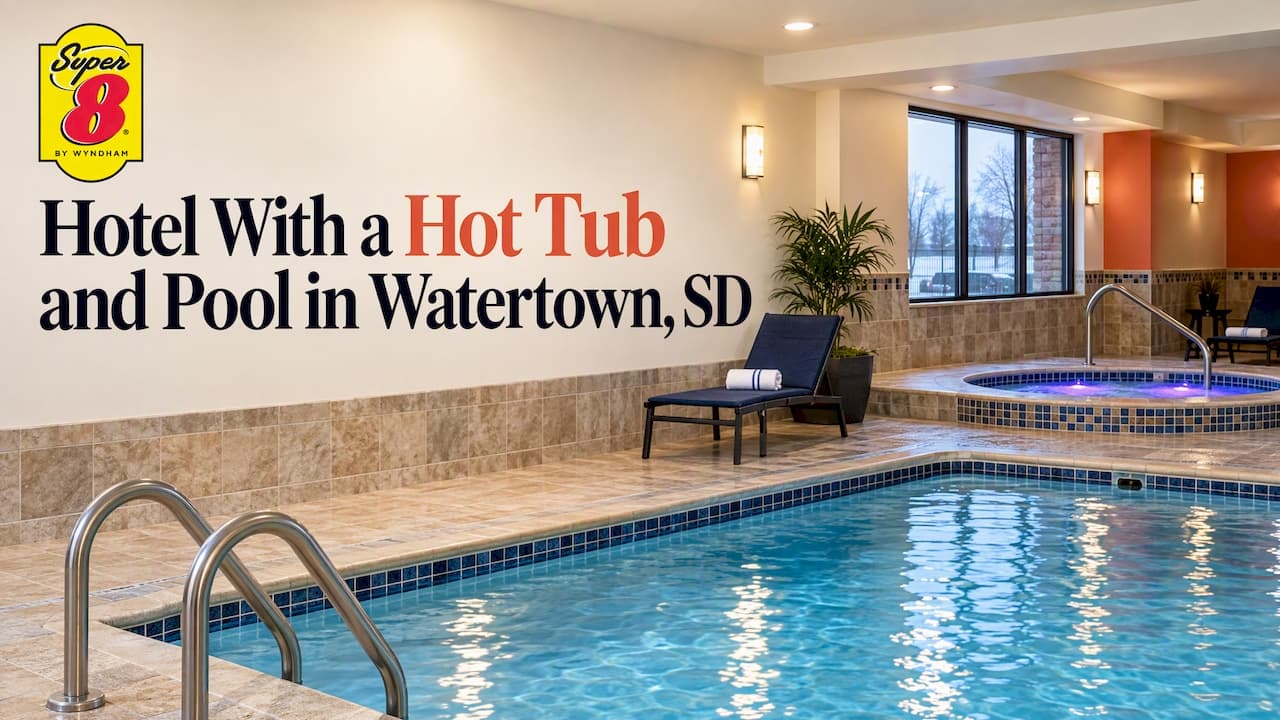
If you want a hotel with a pool and a hot tub in Watertown, South Dakota, our Super 8 by Wyndham at 503 14th Avenue SE has an indoor swimming pool and a hot tub with colorful LED lighting, plus a poolside movie screen and pool volleyball. This guide explains what "pool and hot tub" really means in a hotel listing, how to tell indoor from outdoor, and what to check before you book, so the water is as good as the photos.
TL;DR
- A hotel "with a pool and hot tub" usually means shared amenities in a common pool area, not a private tub in your room. Confirm which one a listing means.
- Indoor means usable in any weather. Ask directly, because listing filters often lump indoor and outdoor pools together.
- The CDC gives concrete water-quality numbers you can use as a checklist: hot tub water at 104°F or below, and a set range for chlorine or bromine and pH.
- Families should look at age rules, drain covers, posted capacity and supervision before anyone gets in.
- Our Super 8 in Watertown offers an indoor pool, hot tub, King and Two Queen rooms, free breakfast, pet-friendly rooms and truck and RV parking.
Table of Contents
- What "hotel with a pool and hot tub" really means
- Indoor or outdoor: how to tell before you book
- Shared pool-area hot tub or private tub in the room
- What to check about water quality, hours and upkeep
- Pool and hot tub safety for families
- Accessibility: what the law says and what to ask
- What to verify for a Watertown stay
- Our Super 8 in Watertown: pool, hot tub and room to spread out
- Our perspective: what a pool is for
- FAQ
- Sources
What "hotel with a pool and hot tub" really means
The phrase covers three different things, and listings rarely tell you which one you are getting.
A shared pool area with a hot tub. This is the most common setup at mid-priced and economy hotels. One room holds the pool and a hot tub, open to all guests during posted hours. It costs nothing extra and suits families, crews coming off a long shift and travelers who want to loosen up after hours behind the wheel.
A pool and a separate hot tub in different places. Some properties have an outdoor hot tub and an indoor pool, or the reverse. A listing that says "pool and hot tub" may be describing both without saying they are in different areas.
A private hot tub or jetted tub in the room. Several of the pages that rank for this search are about suites with in-room whirlpool tubs, which is a different product at a different price. If you want soaking in private, search for suites with in-room tubs. If you want somewhere to swim, relax and let the kids burn off energy, you want a shared pool area.
The practical rule: read the amenity line for the words "indoor," "outdoor," "seasonal," "heated" and "in-room." If none of those appear, the listing has not answered your question yet.

Indoor or outdoor: how to tell before you book
This matters more than most travelers expect. An outdoor pool can be closed for much of the year in a northern state, and even a heated outdoor hot tub is a very different experience in a cold wind than in a warm room.
Here is how to check quickly:
- Read the amenity description, not just the icon. A pool symbol says a pool exists. It does not say where it is.
- Look at the photos. Windows, tile floors, a ceiling and lighting fixtures point to an indoor space. Lounge chairs on grass or a fence point to outdoor.
- Search guest reviews for the words "indoor" and "seasonal." Recent reviews often mention closures, temperatures and crowding.
- Call the front desk. It takes two minutes. Ask whether the pool and hot tub are in the same room, whether they are indoors, and what hours they are open.
If you are searching for an indoor pool and hot tub, ask one more thing: is the hot tub inside the same enclosed area as the pool? Some hotels keep them together, and some do not.
At our Super 8 in Watertown, the swimming pool is indoors and the hot tub sits alongside it, lit with colorful LED lighting. You can swim and soak in the same visit without stepping outside.
Shared pool-area hot tub or private tub in the room
Search results for this topic mix two audiences. Some travelers want a romantic suite with a whirlpool in the room. Others, the bigger group on a family or work trip, want a hot tub they can use after a long day without paying for a suite.
| Shared pool-area hot tub | In-room tub or suite | |
|---|---|---|
| Where it is | Pool area, open to all guests | Inside your room |
| Privacy | Shared, with posted capacity limits | Private |
| Good for | Families, crews, road trips, groups | Couples, special occasions |
| Typical trade-off | Busy at peak hours | Higher room rate, fewer hotels offer it |
| Hours | Set by the hotel | Whenever you like |
The shared option has its own advantage: the water is treated and circulated all day, and a hotel that keeps a pool area open to many guests has an incentive to keep it clean. Whichever you choose, the checks in the next section apply.
What to check about water quality, hours and upkeep
A pool and hot tub only help your stay if the water is properly treated. The CDC publishes plain guidance on this, and you can use it as a checklist at the pool deck.
Temperature. The CDC says hot tub water should be no hotter than 104°F. If you can, check the thermometer posted at the tub.
Disinfectant and pH. The same CDC page recommends at least 3 ppm of free chlorine or 4 to 8 ppm of bromine, with a pH between 7.0 and 7.8. Most guests will not carry a test kit, and you do not need to. Ask whether staff test the water and log the results, and look for a posted log or inspection record. The CDC suggests checking the latest inspection results where they are available.

What you can see and smell. The CDC advises noticing the surroundings: tiles should not feel sticky or slippery, and a strong chemical smell can point to a water-treatment problem rather than a well-chlorinated pool. A pool that smells faintly of chlorine is normal. A harsh, stinging smell in the air is worth reporting to the front desk.
Why it is worth the attention. In a CDC analysis of 493 treated recreational water outbreaks reported in the U.S. from 2000 to 2014, hotels were the leading setting, with 157 outbreaks, or 32%. That figure reflects how many people use hotel pools, not that hotel pools are unsafe, but it shows why monitoring matters. A CDC report on a 2017 hotel outbreak in Tennessee found improper water-treatment monitoring and a chlorine residual of 0 ppm at the aquatics facility, and the facility was closed for remediation.
Hours. Pool hours vary by property and can change with maintenance. Confirm them when you book, and ask whether the pool closes for cleaning at a set time each day. Do not rely on a third-party site for hours.
Maintenance notices. A hotel that is working on its pool should say so when you ask. If a hot tub is out of service, you should hear about it before arrival, not at check-in.
Pool and hot tub safety for families
Families are a big part of the people searching for this, and the safety rules are simple enough to explain to kids on the way in.
Age. The CDC says children under five should not use hot tubs. Younger children can enjoy the pool while an adult uses the tub, or take turns with another adult in the group.
Behavior. The same CDC guidance asks guests to avoid alcohol in and around hot tubs, to shower before getting in, to stay out of the water if they have had diarrhea, and to keep within the posted capacity. A rinse before you swim is a small courtesy that helps keep the water treated for everyone.
Drains. Entrapment injuries are rare but serious. The Consumer Product Safety Commission's report on incidents from 2013 through 2017 found 11 reported circulation entrapment victims, all younger than 15, and seven of the incidents involved spas. Federal guidance under the Pool and Spa Safety Act tells guests to avoid facilities with missing, cracked or visibly damaged drain covers and to follow posted rules. If a drain cover looks wrong, tell the front desk and stay out.
Electricity and wet surfaces. The CPSC notes that wet surfaces raise the risk of shock and lists underwater lights, pumps, filters, cords and outlets as possible sources. In practice: keep phones, speakers and chargers away from the water's edge, and never use a plugged-in device while wet.
Supervision. Rules only help when someone is watching. A hotel pool area is not staffed like a public aquatic center, so an adult needs to be at the water with young swimmers, within arm's reach for the smallest ones.
Accessibility: what the law says and what to ask
If anyone in your group needs help getting into the water, ask about access before you book. Under guidance on the ADA, newly built or altered hotel pools must provide an accessible way in and out. Larger pools with at least 300 linear feet of pool wall generally need two, and smaller pools need at least one. Newly built or altered spas must have at least one accessible entry, such as a transfer wall, transfer system or pool lift, while existing facilities are held to the standard of removing barriers where that is readily achievable.
That is the legal baseline. What matters on your trip is the specific equipment and layout, so ask the front desk what is available at the pool and hot tub, and whether staff can help.
What to verify for a Watertown stay
Watertown sits in the northeast part of South Dakota, and the travelers who stop here are a mix: families on a getaway, hunters, business travelers, wind energy technicians and construction crews on longer assignments. That mix shapes what to check beyond the pool itself.
- Indoor, so it works year round. In a state with cold winters, an indoor pool and hot tub is the version you can count on. Confirm it is indoors, not seasonal.
- Parking for your vehicle. If you tow a trailer, drive a truck or bring an RV, ask whether the lot can handle it. Many city hotels cannot.
- Breakfast. A free breakfast saves a stop on early work mornings and on travel days with kids.
- Pets. If a four-legged companion is coming, confirm the pet policy and any fee before you arrive.
- Stay length. If you are in town for weeks, ask about weekly rates, not just the nightly rate.
- Room layout. A King room suits one or two travelers. Two Queen Beds suits families and crews sharing a room.
Prices change with the season, local events and demand, so ask for the current rate directly instead of relying on a number from an old listing.
Our Super 8 in Watertown: pool, hot tub and room to spread out
We are the Super 8 by Wyndham at 503 14th Avenue SE, Watertown, SD 57201. Here is what is relevant if the pool and hot tub are what brought you here.
- Indoor swimming pool and hot tub, with colorful LED lighting.
- Poolside entertainment: a large movie screen with a 4K projector, and a pool volleyball setup.
- Rooms: King and Two Queen Bed rooms with a 50-inch flat-screen TV and free high-speed Wi-Fi.
- Free continental breakfast with a rotating selection of hot and cold items, including biscuits and gravy, eggs, sausage, waffles, coffee, cereal and yogurt.
- Pet-friendly accommodations.
- Parking for trucks, pickups, trailers and RVs.
- Weekly stays and group booking options for crews and extended assignments.
We do not publish room prices on our page, so ask for current rates directly. To see the rooms and pool, request a group rate or book, start at the Super 8 Watertown page.

If you are bringing a crew, tell us how many rooms and how many nights, and we will go over weekly and crew stays with you.
Our perspective: what a pool is for
Most of our guests are not on a resort vacation. They are driving a long day, working a long shift or keeping two kids entertained in a town they do not know. For them a pool and hot tub is not a luxury. It is the thing that makes the evening feel like part of the trip instead of the end of a workday.
That is why we think of the pool area as part of the room, not an add-on. A tired technician wants hot water on sore shoulders. A family wants the kids to wear themselves out before bedtime. A group of hunters wants somewhere to warm up. The movie screen and pool volleyball exist because a pool area works best when different people can use it in different ways at the same time.
Our advice to any traveler, at any hotel, is to ask three questions before booking: is it indoors, what are the hours, and when was the water last tested? A hotel that answers readily is a hotel that pays attention. We are glad to answer them for ours.
— stayats8llc
FAQ
Does a hotel with a pool and hot tub mean the hot tub is in the room?
Usually not. In most hotel listings, it means a shared hot tub in the pool area that all guests can use during posted hours. A tub inside the guest room is typically described as an in-room whirlpool or jetted tub suite. Check the room description if a private tub is what you want.
Is the pool at your Watertown hotel indoors?
Yes. Our Super 8 in Watertown has an indoor swimming pool and a hot tub with colorful LED lighting. We also have a poolside movie screen and a pool volleyball setup. Ask us for current pool hours when you book.
Can young children use a hotel hot tub?
The CDC says children under five should not use hot tubs. Older children should stay within the posted capacity and rules, and an adult should be with them. Younger children can use the pool with close supervision.
How can I tell if a hotel hot tub is clean?
Look at the surroundings and the water. The CDC says tiles should not be sticky or slippery, and a strong chemical odor can signal a treatment problem. Ask whether staff test the water and keep a log, and report anything that looks or smells wrong to the front desk.
Can we bring a truck, trailer or pet to your hotel?
We offer parking for trucks, pickups, trailers and RVs, and we have pet-friendly accommodations. Tell us what you are bringing when you book so we can confirm the details for your stay.
Sources
- CDC: What You Can Do to Stay Healthy in Hot Tubs
- CDC MMWR: Outbreaks Associated with Treated Recreational Water
- CDC MMWR: Notes from the Field, Legionellosis Outbreak Associated with a Hotel
- CPSC: 2013-2017 Reported Circulation/Suction Entrapment Incidents
- CPSC: Guidance for Safety, The Pool and Spa Safety Act
- CPSC: Don't Swim with Shocks
- ADA.gov: Accessibility Requirements for Pools and Spas